🌵When Dubbing Overwrites the Original Voice in Documentaries and News Interviews
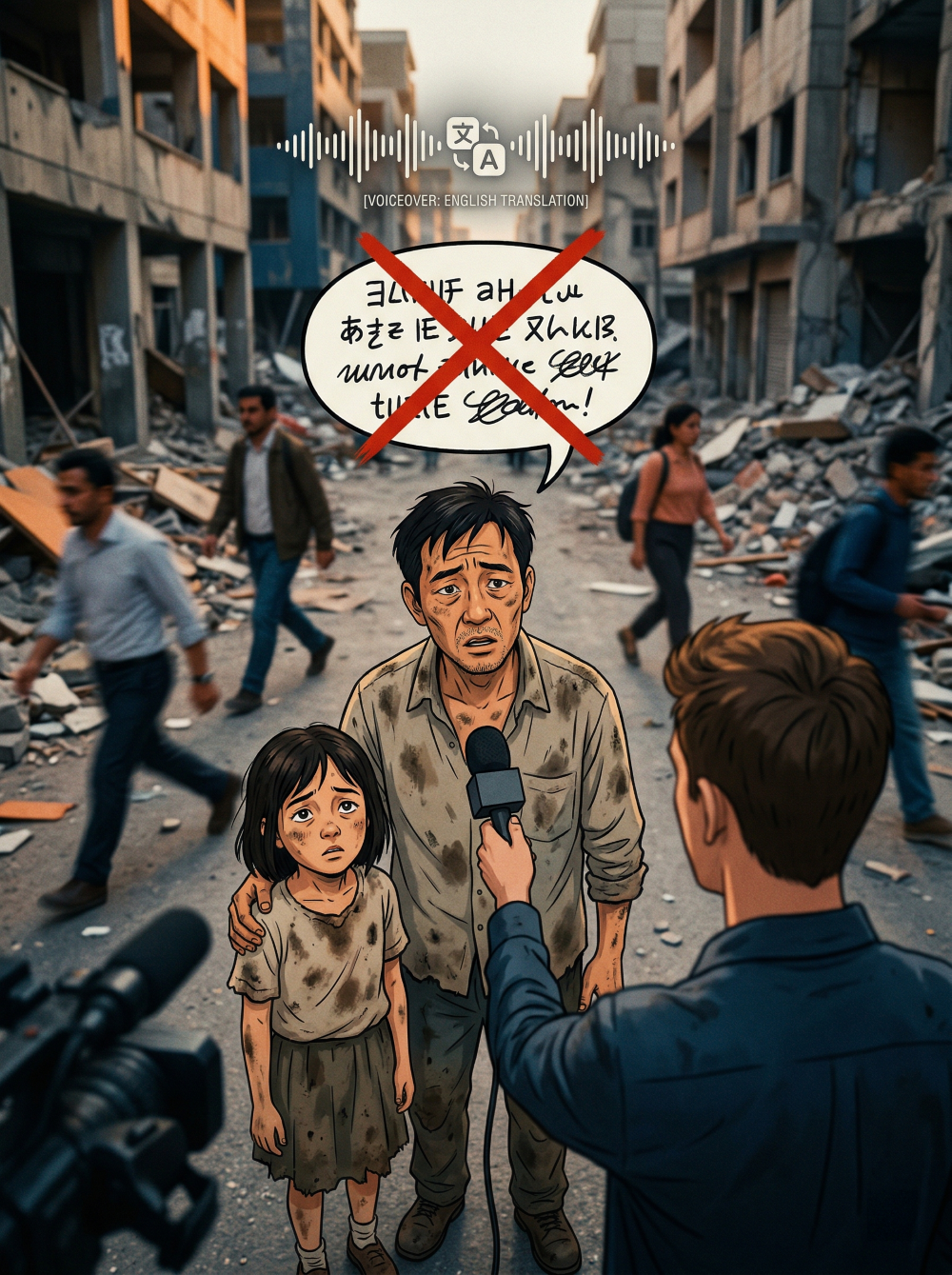
When Dubbing Overwrites the Original Voice in Documentaries and News Interviews
I have wanted to write about this for a while.
Do you know that feeling when you are watching an international news segment and something feels off, even before you can explain why? For me, that happened with American-style news coverage, the kind you would associate with channels like CNN or BBC. I honestly do not remember the exact first clip I saw, but I remember the reaction very clearly.
Someone on screen was obviously speaking, and yet I could barely hear that person at all. What I heard instead was a flat, assertive layer of English dubbing covering the original voice.
That bothered me more than I expected. Because what I wanted was not just the translated meaning. I wanted to hear the actual person. Even when I do not understand the language, I still want some access to the rhythm, the pressure, the uncertainty, even the accent.
Sometimes it is simple curiosity. Russian in films often sounds low and heavy to me, and I find myself wondering whether people in real life sound like that too. The same goes for voices from countries I know very little about. What do they actually sound like when they speak naturally? Once everything is overwritten, the information may still be there, but the encounter with a real person is thinner.
So whenever I watch documentaries or interview-driven programs now, I keep coming back to the same thought: someone on screen is clearly speaking, but the voice I hear no longer feels like theirs. At that point, translation is not just helping me understand. Someone else has stepped in and taken over the rhythm, breath, and tone of the original speaker.
In fiction, dubbing can be a perfectly legitimate form of localization. But once we move into international news interviews, documentaries, testimonies, and historical footage, the question becomes much more delicate. Non-fiction does not only tell us what was said. It also preserves who said it, and how.
Dubbing is not the enemy. Erasing the original voice in news and documentary work is.
To be clear, I am not against dubbing as a whole.
Dubbing can be valuable for children, for viewers who struggle with subtitles, and for audiences who need a lower reading burden. It helps works travel across languages, and accessibility matters.
But in news interviews and documentary practice, there is more than one way to translate audiovisual speech:
- Subtitles keep the original voice and add written translation.
- Voice-over lays the translated speech over the source audio while leaving the original faintly audible underneath.
- Full dubbing replaces the original voice almost entirely.
The third option is where my resistance really begins. Once the source voice disappears, the audience is no longer hearing a translated person. It is hearing a re-performed version of that person.
That is the part that feels wrong to me. It is not that translation exists. It is that the speaker has effectively been muted.
Why original voices matter more in news interviews and documentaries
1. A voice is part of the evidence
Accent, tempo, hesitation, breath, and vocal strain are not decoration. They are information.
They may reveal class, region, emotion, fear, confidence, exhaustion, or the pressure of being filmed. If an interview subject originally speaks slowly and cautiously, but the dub turns that into a polished and fluent delivery, the factual meaning may remain similar while the person on screen becomes someone else.
2. Silence and hesitation are part of the testimony
Fiction often aims for smoothness. News interviews and documentaries often need roughness.
Some of the strongest moments in non-fiction are not elegant lines, but pauses before an answer, a change in tone, a sentence that stops halfway, or a voice that tightens at a specific memory. These details do not always survive translation, and they almost never survive clean replacement. That is true in documentary scenes, but it is also true in news interviews where hesitation and pressure are part of what the audience is supposed to perceive.
That is why original audio matters. It carries the human residue of the moment.
3. Translation is never invisible
Every translation makes choices, and dubbing makes even more of them. It does not only transfer meaning. It assigns tone.
Should a line sound calm, angry, bitter, warm, restrained, resigned? Once a new voice performs the translated line, interpretation enters the soundtrack. That may be acceptable in animation or commercial entertainment. In news interviews and documentary work, it can become too intrusive.
Then why do broadcasters and platforms still dub?
Because dubbing does solve real problems.
First, it is simply easier to follow. Not everyone wants to split attention between reading text and watching images. For children, older viewers, commuters, or people with slower reading speed, dubbing can genuinely make access easier. In some markets, television was also built around the assumption that people would watch while doing other things around the house, not while sitting there fully focused on subtitles.
Second, it matches audience habits in certain places. Some viewers are just more comfortable hearing everything in their own language, and platforms are built around that expectation. The heavy overdub style common in parts of American broadcast news reflects exactly that logic. It prioritizes immediate comprehension over preserving the original voice as a piece of evidence.
Third, it is easier to standardize. When a service has a large catalog and aggressive release schedules, full dubbing can look like the most complete localization package.
And this logic is not limited to international news. You can see parallel cases elsewhere. Some dubbed Korean dramas were clearly shaped for viewers who wanted to follow the story while doing housework or other tasks. Or take Stephen Chow films: dubbing helped those movies travel much further across the Chinese-speaking world. So I am not trying to pretend dubbing has no value. Sometimes it works extremely well.
My point is narrower than that. Once the material shifts from entertainment into news interview, documentary, testimony, or historical record, the standard should shift too.
So dubbing in news interviews and documentaries persists not because the industry is unaware of authenticity, but because convenience, market convention, and distribution pressure often win.
AI will make this argument sharper, not smaller
In the past, producing a dubbed track still required actors, studio time, and post-production. AI is making that replacement faster, cheaper, and easier to scale.
That sounds like progress, and in some ways it is. More language options can help more people reach a work. But the danger is equally obvious: when replacing a voice becomes almost frictionless, preserving the original voice starts to look optional.
In fiction, AI dubbing raises questions about quality and labor. In news interviews and documentaries, it raises ethical questions.
If the speaker is a survivor, a migrant worker, a civilian in a war zone, or a witness to a historical event, the voice is not just a delivery channel. It is part of the record. You can translate the words, but if you replace the breath, pressure, and sonic identity with a smoother synthetic performance, news interviews and documentary work both start moving away from documentation and toward re-packaging.
A better approach is not either-or
I do not think this needs to turn into a subtitles-versus-dubbing culture war. It makes more sense to handle different kinds of material differently.
At minimum, three principles seem reasonable:
News interviews, documentaries, and testimonial scenes should preserve original audio by default.
The strongest option is original voice plus subtitles. If readability is a concern, voice-over that still leaves the original audible is often a better compromise than full replacement.If full dubbing is offered, the original audio track should remain available.
Viewers should be allowed to choose. Platforms should not decide in advance that one way of understanding is enough for everyone. I am not asking for dubbing to disappear. I am asking for the option to switch back to the original voice.AI-generated or AI-assisted dubbing should be clearly labeled.
That is not only technical transparency. It is a basic act of respect toward audience trust.
Good localization does not sand every edge off a foreign voice. It helps audiences cross the language barrier while still meeting the real person on the other side.
Conclusion: translation should be a bridge, not an eraser
What makes news interviews and documentaries special is that they let us meet people we otherwise would never encounter. That encounter happens through images, yes, but also through sound. Voices carry history, vulnerability, emotion, social position, and the part of truth that resists polishing.
So the core question is not whether translation should exist. It is whether translation should erase the person while helping us understand them.
If dubbing helps more people reach a work, that is worth appreciating. But when the work is non-fiction, when it is built from testimony, memory, and lived experience, I still want the original voice to remain.
If dubbing has to be used, I would rather see it done with more humility: closer to the speaker's original tone, pacing, emotional weight, and even accent, instead of flattening everyone into the same smooth broadcast voice.
But even that is secondary to the more basic issue. The original audio should not disappear.
In news interviews and documentaries, hearing how someone speaks is often part of hearing who they are.