🌳Global Semiconductor & Automation Industry Key Enterprises Directory
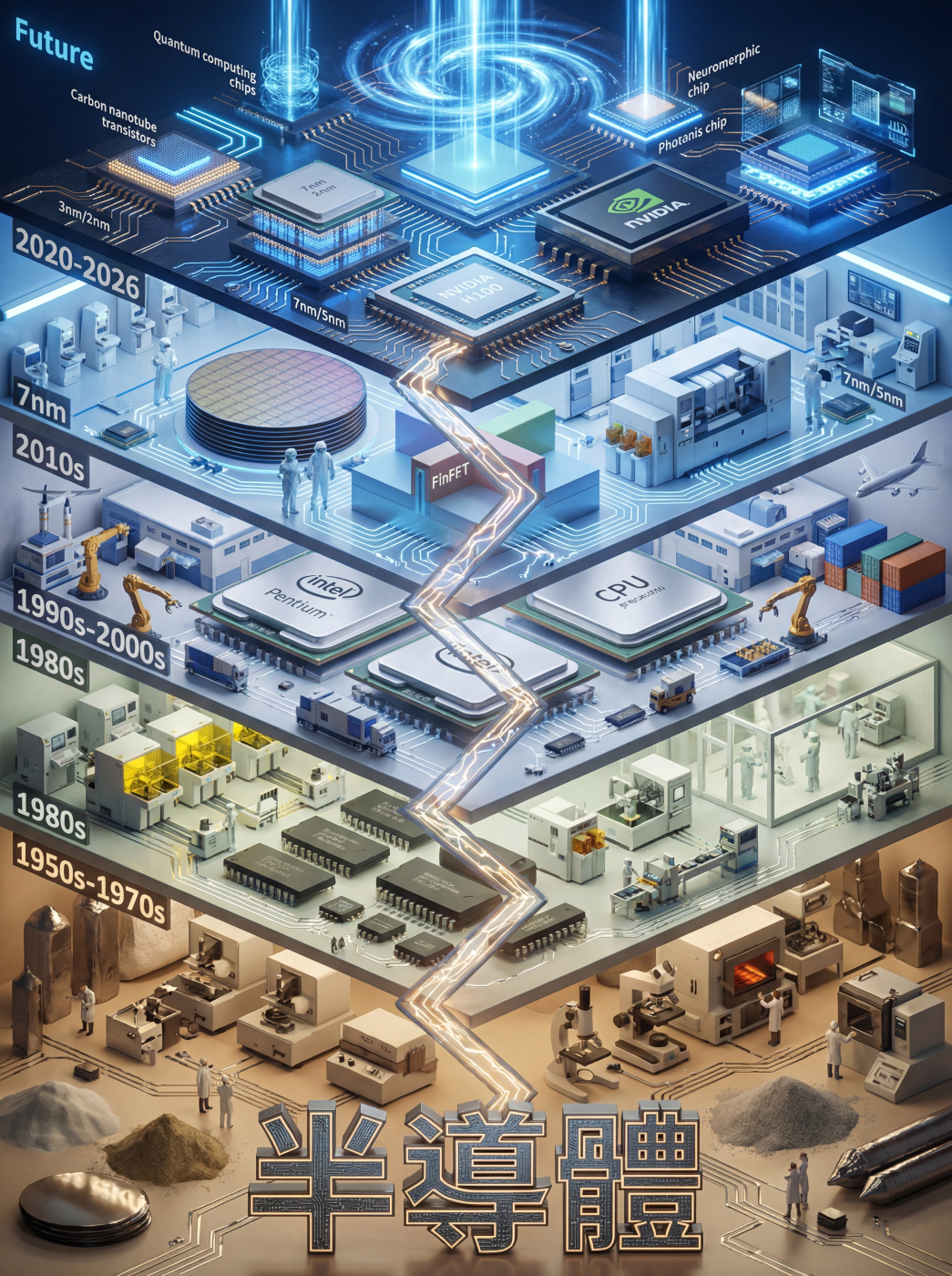
✨ Image Features
Frameless Design: Completely removes baseboards and frames, with the foundation directly on silicon wafer raw materials
Vertical Timeline: A zigzag path ascending from the 1950s materials layer to 2026 and beyond
Tilt-Shift Effect: Exquisite rendering in Cinema 4D + Octane Render style
🏗️ Vertical Layers
Bottom: Silicon wafer materials, early transistors, vintage warm lighting
Lower-Middle: Integrated circuit revolution, IC chips, cleanrooms
Middle: CPU processors, 8-inch wafers, global expansion
Upper-Middle: Nanometer processes, EUV lithography machines, 3D transistors
Top: 3nm advanced processes, AI chips, 3D packaging
Apex: Future technologies such as quantum computing and photonic chips
1. Integrated Device Manufacturer (IDM)
Introduction
Integrated Device Manufacturer (IDM) is the most classic business model in the semiconductor industry, characterized by the vertical integration of the entire process from design and manufacturing to sales. This model empowers enterprises with ultimate control over product performance optimization, quality assurance, and trade secret protection. However, the immense capital expenditure required to maintain such a massive system becomes a burden when responding to rapid market changes. Under geopolitical pressures and the trend of industry specialization, traditional IDMs are undergoing profound transformation. Intel's "IDM 2.0" strategy is a prime example. This strategy not only aims to revitalize its process technology but also intends to leverage the U.S. CHIPS Act to open up foundry services, positioning itself as the preferred manufacturer for the Western bloc to counter Asia's absolute dominance in advanced manufacturing.
Enterprise List
| Company Name | HQ | Core Business & Market Positioning |
|---|---|---|
| Intel | USA | The market dominator for traditional PC processors (x86 CPU) and server chipsets. Its IDM 2.0 strategy aims to regain manufacturing leadership and compete directly with TSMC and Samsung through Intel Foundry Services (IFS), serving as the core of America's semiconductor manufacturing reshoring policy. |
| Samsung Electronics | South Korea | The absolute leader in global DRAM and NAND Flash memory markets. Its business spans smartphone SoCs (Exynos) and image sensors, while also being the world's second-largest foundry, making it the only enterprise capable of challenging TSMC in advanced processes. |
| SK Hynix | South Korea | The world's second-largest manufacturer of DRAM and High Bandwidth Memory (HBM), and a major supplier in the NAND Flash market. Together with Samsung, it dictates the global memory market and is a critical link in the AI server supply chain. |
| Micron Technology | USA | One of the world's major manufacturers of DRAM and NAND Flash memory, ranking third in the market. It is a strategic enterprise for the US in the memory sector. |
| Texas Instruments (TI) | USA | A leader in global analog ICs and embedded processors, possessing an extremely broad product line and customer base. Deeply rooted in high-stability markets such as industrial, automotive, and consumer electronics, it serves as a bellwether for industry trends. |
| Infineon Technologies | Germany | The absolute leader in global power semiconductors with a 22.8% market share. Its products are core to high-power applications like electric vehicles, renewable energy, and industrial automation, holding a strategic position in automotive semiconductors. |
| STMicroelectronics | Switzerland | One of Europe's largest semiconductor manufacturers. Its core products include Microcontrollers (MCUs), sensors, and automotive semiconductors, with profound strength in industrial and automotive electronics sectors. |
| NXP Semiconductors | Netherlands | One of the world's largest automotive semiconductor suppliers. Leveraging its leadership in secure connectivity, automotive processors, and Advanced Driver Assistance Systems (ADAS) chips, it is deeply integrated into the global automotive supply chain. |
| Renesas Electronics | Japan | Japan's largest semiconductor manufacturer, holding global leadership in automotive Microcontrollers (MCUs) and possessing deep capabilities in analog ICs and power semiconductors. |
| ON Semiconductor | USA | A major supplier of power semiconductors, image sensors, and automotive semiconductors. With an 11.2% market share, it ranks second in the global power semiconductor market and is a key component supplier for EVs and energy infrastructure. |
| Microchip Technology | USA | A leader in the global Microcontroller (MCU) market, with products covering 8-bit, 16-bit, and 32-bit MCUs. It also provides analog ICs and memory products, occupying a significant position in the embedded control sector. |
| Gree Electric (Zhuhai Gree) | China | A small-scale IDM originating from a home appliance giant diversifying into semiconductors. It primarily designs and manufactures MCUs, power semiconductors (SiC), and AIoT chips for its own appliance products, epitomizing China's industrial self-reliance strategy. |
Summary & Transition
IDM giants, with their deep accumulation in specific fields like memory, analog ICs, and power semiconductors, form the bedrock of the global semiconductor industry. However, their high capital barriers have also given rise to a more flexible vertical specialized model. Fabless design houses, which focus purely on intellectual crystallization, are the product of this model. They outsource the shackles of innovation—manufacturing—thus becoming the core engines driving the industry's frontier trends.
2. Fabless IC Design Houses
Introduction
The rise of the Fabless business model stripped away the capital-intensive manufacturing link, allowing enterprises to focus entirely on core strengths like IC design, algorithm development, and marketing, thereby drastically lowering the barrier to entry. This asset-light, high-intellect model has been the core driver of technological innovation over the past few decades, birthing leading enterprises in cutting-edge fields like Artificial Intelligence (AI), mobile communications, and High-Performance Computing (HPC). Their staggering market capitalizations are a direct reflection of super-trends like AI and data centers, leading the wave of global technological development.
Enterprise List
| Company Name | HQ | Core Business & Market Positioning |
|---|---|---|
| NVIDIA | USA | The absolute leader in global GPUs. Through its CUDA parallel computing platform, it successfully transformed GPUs from graphics components into standard equipment for AI training and inference, building an almost unassailable ecosystem moat in AI computing and data center markets. |
| Broadcom | USA | A leader in networking and communication chips, with a product line covering server storage, broadband, and wireless communication chips. Its custom AI chip design capabilities make it a core supplier for global data centers and communication infrastructure. |
| AMD | USA | A key player in High-Performance Computing. Its Ryzen series CPUs and Radeon series GPUs compete directly in the PC market. EPYC series server processors and MI series AI accelerators occupy significant shares in the data center market. |
| Qualcomm | USA | The leader in global smartphone System-on-Chips (SoCs). Its Snapdragon series processors dominate the high-end Android market. It also holds a leading position in 5G baseband chips and automotive digital cockpit platforms. |
| MediaTek | Taiwan | The champion in global smartphone chip shipment volume. Its Dimensity series SoCs perform strongly in mid-to-high-end markets, successfully challenging traditional market structures. Its product line also extends to smart homes and IoT applications. |
| Apple | USA | A unique closed-ecosystem IC designer. Its self-designed A-series (iPhone/iPad) and M-series (Mac) chips are renowned for superior power efficiency and hardware-software integration, used exclusively in its own products and not sold externally. |
| Marvell Technology | USA | Focuses on data center infrastructure chips, providing solutions including networking, storage, and security processors. It is a key supplier for cloud computing and 5G infrastructure. |
| Analog Devices (ADI) | USA | A leader in high-performance analog ICs, mixed-signal, and Digital Signal Processing (DSP). Its products are crucial in markets requiring high-precision signal processing, such as industrial automation, communications, and medical equipment. |
| Realtek | Taiwan | A global leader in networking and multimedia IC design. Its Ethernet, Wi-Fi, and Audio Codec chips are known for their high price-performance ratio, widely used in PCs and consumer electronics. |
| Novatek | Taiwan | A market leader in global Display Driver ICs (DDI) and Timing Controllers (TCON), serving as one of the most core chip suppliers in the display panel supply chain. |
| ESWIN Computing | China | A rising star in IC design focusing on next-generation RISC-V computing architecture. It targets intelligent solutions for smart terminals and embodied AI (e.g., robotics), representing China's pursuit of breakthroughs in emerging architectures. |
Summary & Transition
These digital blueprints dominated by a few Western companies would hold no strategic value if there were no manufacturing capabilities to physically realize them. This highlights the crucial importance of the next link—a domain where Asia, and specifically Taiwan, has established near-absolute dominance.
3. Electronic Design Automation (EDA) & Silicon IP
Introduction
Electronic Design Automation (EDA) tools and Silicon Intellectual Property (IP) licensing represent the most geopolitically sensitive "choke point" in the entire IC design process. EDA acts as the "operating system and drawing software" for chip design, enabling complex designs with billions of transistors; IP serves as "reusable design blueprints," allowing designers to directly integrate mature functional modules like CPU cores. This sector is highly monopolized by a few giants like Synopsys (31%) and Cadence (30%) from the US, making it a strategic high ground for controlling the source of global chip design and technical standards.
Enterprise List
| Company Name | HQ | Core Business & Market Positioning |
|---|---|---|
| Synopsys | USA | The world's largest EDA supplier (31% market share), providing a full suite of solutions from front-end design and back-end verification to manufacturing assistance. Its most comprehensive product line gives it a near-monopoly status in the industry. |
| Cadence | USA | The world's second-largest EDA supplier (30% market share), traditionally strong in analog circuit design and verification tools. Its solutions are the industry standard for mixed-signal and RF IC design. |
| Siemens EDA | Germany | The world's third-largest EDA supplier, formerly Mentor Graphics. Leveraging Siemens' integration capabilities in industrial software, it offers powerful Digital Twin and system-level verification solutions. |
| Arm Holdings | UK | The absolute leader in global mobile processor architecture with a market share exceeding 95%. Its IP licensing model fosters a massive collaborative ecosystem, lowering the barrier for chip design and making its architecture ubiquitous, effectively becoming an industry standard. |
Summary & Transition
Once the precise digital blueprints are drawn, the next step is to bring them from the virtual world into physical reality. This process requires extremely precise manufacturing craftsmanship, which represents the core value of specialized Foundries and acts as the physical battlefield of geopolitical games.
4. Foundry
Introduction
The specialized Foundry model pioneered by TSMC has completely reshaped the vertical division of labor in the global semiconductor industry. This link is highly capital and technology-intensive and acts as the decisive force in enabling AI and High-Performance Computing chips. The current semiconductor market shows significant "polarization": AI demand drives utilization rates for advanced processes at TSMC to record highs; meanwhile, mature processes face potential risks of global overcapacity due to massive expansion in mainland China supported by national strategy. Simultaneously, geopolitical pressure drives leaders like TSMC to expand globally, facing the severe challenge of significantly higher production costs in the US and Japan compared to Asia.
Enterprise List
| Company Name | HQ | Core Business & Market Positioning |
|---|---|---|
| TSMC | Taiwan | The world's largest pure-play foundry, with a 67% market share in Q4 2024. It holds absolute leadership in 3nm and 5nm advanced processes and is the sole or primary supplier for top design firms like Apple and NVIDIA, controlling the lifeline of AI chip manufacturing. |
| Samsung Foundry | South Korea | The world's second-largest foundry (approx. 11% market share) and TSMC's main competitor in advanced processes. Its advantage lies in the ability to integrate memory and logic chip manufacturing within the same group. |
| UMC | Taiwan | The world's third-largest pure-play foundry (approx. 7% market share). Strategically focuses on stable and cost-effective mature processes (e.g., 28nm and above) to serve high-volume markets like automotive, industrial, and IoT, avoiding the massive capital race of advanced processes. |
| GlobalFoundries | USA | The world's fourth-largest pure-play foundry (approx. 6% market share). Focuses on specialty processes for RF, automotive electronics, and IoT. It is the largest pure-play foundry based in the US. |
| SMIC | China | Mainland China's largest and most technologically advanced foundry (approx. 5% market share). It plays a core role in China's semiconductor independence strategy, concentrating efforts on expanding mature process capacity. |
| PSMC (Powerchip) | Taiwan | Focuses on DRAM foundry and specialty logic processes. Adopts a unique Open Foundry model, providing customer-oriented memory and logic integration solutions. |
| Vanguard (VIS) | Taiwan | Focuses on 8-inch wafer mature processes, mainly producing analog chips like Power Management ICs (PMIC) and Display Driver ICs. A key player in the mature process market. |
| Tower Semiconductor | Israel | A global leader in specialty processes for analog ICs, RF, and sensors, possessing deep technical accumulation in niche markets. |
Summary & Transition
The success of wafer manufacturing is like building a skyscraper in a microscopic world, where every brick and tile comes from upstream suppliers providing ultra-precise equipment and high-purity materials. These links, due to their extremely high technical barriers, form another class of more hidden, yet equally lethal, strategic choke points.
5. Key Equipment & Materials Suppliers
Introduction
Semiconductor equipment and materials are the foundation of the entire supply chain. Their high technical barriers and market monopoly levels constitute the most deterrence-capable strategic nodes in geopolitics. ASML from the Netherlands is the sole global supplier of EUV lithography equipment, holding the "power of life and death" over advanced processes below 7nm. In the materials sector, Japanese companies occupy about 52% of the global market share. Their monopoly in fields like photoresists and high-purity silicon wafers was proven to be a powerful "asymmetric strategic tool" during the 2019 export restrictions against South Korea.
Enterprise List
| Company Name | HQ | Core Business & Market Positioning |
|---|---|---|
| ASML | Netherlands | The sole global provider of EUV lithography equipment, monopolizing the exposure equipment market essential for all advanced process chip production, holding a unique geopolitical strategic position. |
| Applied Materials (AMAT) | USA | One of the world's largest semiconductor equipment makers. Its product line is extremely broad, covering multiple key process steps like Deposition, Etch, Ion Implantation, and Inspection. |
| Lam Research | USA | A global leader in Etch and Deposition equipment. It runs neck and neck with Applied Materials, especially in the etching equipment sector where it holds a market leading position. |
| Tokyo Electron (TEL) | Japan | Japan's largest semiconductor equipment manufacturer. It holds absolute monopoly status in Coater/Developer equipment and possesses high market share in certain etching equipment segments. |
| KLA Corporation | USA | The absolute leader in process control and yield management solutions. Its advanced inspection and metrology equipment are key to ensuring foundry yields. Revenue grew 15.8% in 2024. |
| Advantest | Japan | A global leader in back-end Automated Test Equipment (ATE). Its testers and handlers are the final line of defense for ensuring chip quality before shipment. Revenue grew by 32.3% in 2024. |
| Screen Holdings | Japan | A major Japanese semiconductor equipment manufacturer, specializing in wafer cleaning equipment and coater/developers, playing a critical role in specific process steps. Revenue grew 22.4% in 2024. |
| Shin-Etsu Chemical | Japan | The world's largest supplier of semiconductor silicon wafers. It also holds a significant position in key chemicals like photoresists, acting as the upstream material giant of the supply chain. |
| SUMCO | Japan | The world's second-largest supplier of semiconductor silicon wafers. Together with Shin-Etsu Chemical, it dominates the global silicon wafer market, indispensable sources of basic materials for manufacturing. |
Summary & Transition
A wafer manufactured through hundreds of precise steps is still only a semi-finished product. It needs to go through downstream dicing, packaging, and testing to be transformed into a functionally complete, physically protected final chip product. This link is becoming the focus of innovation in the post-Moore's Law era.
6. Outsourced Semiconductor Assembly and Test (OSAT)
Introduction
In the post-Moore's Law era, the role of OSAT houses is evolving from traditional protection and connection to becoming the key technical core for realizing heterogeneous integration and enhancing comprehensive chip performance. As Chiplet architectures become mainstream, advanced packaging technologies like System-in-Package (SiP) have become critical paths for continuing chip performance growth. Against this backdrop, mainland China's OSAT firms are rising with astonishing double-digit growth rates, aiming to build a self-sufficient closed supply chain around their massive mature process capacity.
Enterprise List
| Company Name | HQ | Core Business & Market Positioning |
|---|---|---|
| ASE Technology | Taiwan | The world's largest OSAT, with a market share far ahead of others. It holds global leadership in advanced packaging technologies like SiP and CoWoS, being a key driver for realizing heterogeneous integration of AI chips. |
| Amkor Technology | USA | The world's second-largest OSAT, offering full-spectrum services from traditional to advanced packaging. It has a deep layout in high-reliability fields like automotive electronics. |
| JCET Group | China | The world's third-largest OSAT and the largest in mainland China. Benefiting from domestic market demand and national policy support, its revenue grew 19.3% year-on-year in 2024, showing rapid expansion. |
| Powertech Technology (PTI) | Taiwan | The world's fourth-largest OSAT. Strategically specializes in packaging and testing services for memory chips like DRAM and NAND Flash, serving as a key partner in the global memory supply chain. |
| Hua-Thai Electronics | Taiwan | Specializes in packaging and testing for NAND Flash controller chips and memory card modules. Also operates Electronics Manufacturing Services (EMS), holding a unique market position in storage products. |
Summary & Transition
From design to the final product, efficient semiconductor manufacturing processes rely heavily on a stable, clean, and highly automated factory environment. Without Automated Material Handling Systems (AMHS) serving as the central nervous system, the high yield and output of modern fabs would be impossible. This makes factory automation a critical force supporting the semiconductor industry.
7. Semiconductor & Industrial Automation Key Enterprises
Introduction
Factory automation, particularly Automated Material Handling Systems (AMHS), is an indispensable core competency in modern semiconductor manufacturing. In cleanrooms where cleanliness requirements are extreme, AMHS replaces manual labor, not only fundamentally eliminating human sources of contamination but also maximizing production efficiency and equipment utilization through precise central dispatching. From Overhead Hoist Transport (OHT) systems to automatic warehousing systems (Stockers), this nervous system-like setup is strategic infrastructure ensuring fabs maintain high yields and stable output.
Enterprise List
7.1 Representative Asian Companies
| Company Name | HQ | Core Business & Market Positioning |
|---|---|---|
| Mirle Automation | Taiwan | A benchmark enterprise in Taiwan's semiconductor automation field, successfully breaking the monopoly of Japanese manufacturers. Provides whole-fab automation solutions like OHT, AGV, and Stockers, serving as a key partner for Taiwan's smart factories. |
| Murata Machinery | Japan | A titan in the global Clean FA (Factory Automation) field. Its OHT and Stocker systems are renowned for extreme reliability and are widely adopted by top global fabs, being key drivers of unmanned semiconductor production. |
| Daifuku | Japan | One of the world's largest material handling equipment manufacturers with deep technical heritage. Its business extends from traditional logistics to cleanroom AMHS solutions for semiconductor and panel industries. |
| FANUC | Japan | The world's largest supplier of industrial robots and CNC systems. Its high-precision, high-speed robots are widely used in wafer handling, packaging, and precision assembly of electronic products. |
| Delta Electronics | Taiwan | A leading global provider of industrial automation and power management solutions. Its product line covers PLCs, drives, and robots, providing foundational components for building smart factory control layers. |
7.2 Representative American Companies
| Company Name | HQ | Core Business & Market Positioning |
|---|---|---|
| Rockwell Automation | USA | A leader in North American factory automation and PLC control systems. Its FactoryTalk digital platform and Logix control systems are benchmarks for manufacturing modernization and digital integration. |
| Emerson | USA | An expert in global Process Automation. Its DeltaV distributed control system is widely used in continuous processes like gas and chemical supply within semiconductor facility systems. |
| Honeywell | USA | Business spans process automation and warehouse logistics technology. Its solutions are widely applied in facility control and back-end warehouse digitization. |
| NVIDIA | USA | Its GPUs not only drive AI computing but also provide core computing power for machine vision and Autonomous Mobile Robots (AMR) in modern automation systems, key to realizing smart factories. |
| Intel | USA | Its processors are widely used in Industrial PCs (IPCs) and edge computing devices, forming the computing foundation for factory automation control layers and data acquisition systems. |
7.3 Representative European Companies
| Company Name | HQ | Core Business & Market Positioning |
|---|---|---|
| Siemens | Germany | The global leader in industrial automation and digitalization software. Its TIA Portal and other platforms build end-to-end digital twin solutions from design and simulation to operation, defining Industry 4.0. |
| ABB | Switzerland | A global leader in industrial robotics, motion control, and power technology. Its robots and automation solutions are widely used in semiconductor back-end assembly and electronics manufacturing. |
| KUKA | Germany | A leading global manufacturer of industrial robots, particularly representative in automotive manufacturing and smart factory systems. A core enterprise in Germany's Industry 4.0 strategy. |
| ASML | Netherlands | The sole global supplier of EUV lithography machines. The equipment itself is the ultimate embodiment of industrial automation, integrating ultra-high-precision motion control, optical systems, and software algorithms. |
| Infineon | Germany | A global leader in power semiconductors. Its products are the core power components driving industrial motors, robots, and automated equipment efficiently, acting as the power source for automation systems. |