🌿Digital Garden Blog!?
Foreword
When I was developing this blog, my original intention was to share knowledge.
However, I also fell into a worry: based on past experience, I rarely have the time or energy to write complete articles.
If it's not complete, I dare not publish it.
(As for what counts as complete, I think everyone has their own definition.)
Later, while researching, I discovered the concept of the Digital Garden.
I felt like I had found a treasure.
This way, I don't have to worry—I can just throw out an idea first, and then slowly reinforce it later.
Including this post: I'll first organize the information I've found, and then slowly reinforce it later.
Below is the information found, organized with the help of AI:
Shedding the Pressure of the Timeline: 4 Disruptive Perspectives on 'Digital Gardens' You Should Know
Introduction: Why are your notes always in the draft box?
If this is your dilemma, then the concept of a "Digital Garden" might be your answer.
It is not another note-taking app or writing technique, but a philosophy of knowledge management and publishing that liberates creative pressure and is more faithful to our true thinking process.
This article will share 4 core perspectives on Digital Gardens.
1. Core Metaphor: Your Website is a "Garden", Not a "Stream"
Traditional blogs or social media are essentially a "Stream". Scholar Mike Caufield's core metaphor precisely points out the fundamental difference between the two information models:
- Stream: Content is arranged in reverse chronological order, like a social media feed. It values ephemeral, immediate, and easily self-affirming viewpoints; old content is quickly washed away by new information.
- Garden: A knowledge space connected by themes and concepts. It does not emphasize the timing of publication, but values the long-term cultivation, iterative updating, and interconnection of content, allowing thoughts to grow slowly.
This perspective is important because it challenges our established impression of "publishing". The "Stream" model encourages us to chase immediacy, leading to the decay of knowledge; The "Garden" model allows us to engage in deeper thinking and connection, enabling knowledge to compound over time, eventually forming a unique and precious personal asset.
It is a living organism, not a static library.
2. Embrace Imperfection: Content is Always in "Beta"
The most disruptive perspective of the Digital Garden is that it does not seek to publish "finished drafts", but encourages "Learning in Public". Your ideas don't need to wait until they are flawless to be born; they can exist at different stages of growth, evolving constantly with your learning.
This model divides content maturity into several stages:
- Seed: A very preliminary idea. It might just be a quote, a snippet of code, or a hypothesis to be verified.
- Budding: The idea has started to have a preliminary structure, but still needs supplementary information or in-depth research.
- Evergreen: Content that has undergone multiple revisions and maintenance, is relatively mature, and has long-term reference value.
This model greatly lowers the psychological threshold for writing.
You don't have to wait until you become an expert in a field to dare to speak; instead, you can start from a tiny "seed" and let your knowledge grow in sync with your learning process.
This method transforms the garden from a simple publishing platform into a functional "Second Brain"— A space for dynamically processing and developing ideas, not just displaying them.
3. Structural Revolution: Topology Replaces Timeline
The structure of a traditional blog is a linear timeline (Chronology), where readers can only follow the path from "newest to oldest".
The Digital Garden brings a structural revolution, adopting a web-like topological structure (Topology).
The key to realising this web-like structure is "Bi-directional linking".
Articles are no longer isolated islands, but knowledge nodes interconnected through concepts and themes.
This completely changes the reading experience: readers no longer simply "scroll back", but freely "jump" between different themes, Engaging in exploratory "rabbit hole" wandering, thereby discovering unexpected connections.
To use a simple metaphor: it's like the organisation of a knowledge base, Changing from "folders sorted by date" to "Wikipedia pages that can link to each other". (Technically speaking, this represents a shift from a time-ordered query to a graph-like structure, where "relationships" themselves are as important as the content.)
4. Historical Origins: An Old Concept Born to Cope with Contemporary Internet Culture
You might think the Digital Garden is a new trend from recent years, but a surprising fact is: Its intellectual roots can be traced back to the early days of the internet, an old concept revived to cope with contemporary internet culture.
1998, Mark Bernstein: Hypertext researcher Mark Bernstein first proposed the term "Hypertext Gardens". However, his discourse at the time focused more on user experience and content organisation of websites, rather than the philosophy of personal knowledge cultivation we understand today.
2015, Mike Caufield: After the rise of the "Stream" culture of social media, Scholar Mike Caufield published the foundational article "The Garden and the Stream", re-contextualising and deepening the concept. He positioned the "Garden" as a profound reflection on the algorithm-driven, fleeting and noisy "Stream" culture, laying the foundation for the core philosophy of the modern Digital Garden.
Since then, promoted by thinkers like Maggie Appleton and Tom Critchlow, this concept has re-entered the public eye. The reason it is popular today is precisely because it offers a solution to counter the algorithm-driven, fleeting, and noisy "Stream" culture, Allowing us to build a quieter, more personalised thinking space that we can control autonomously.
Infographic
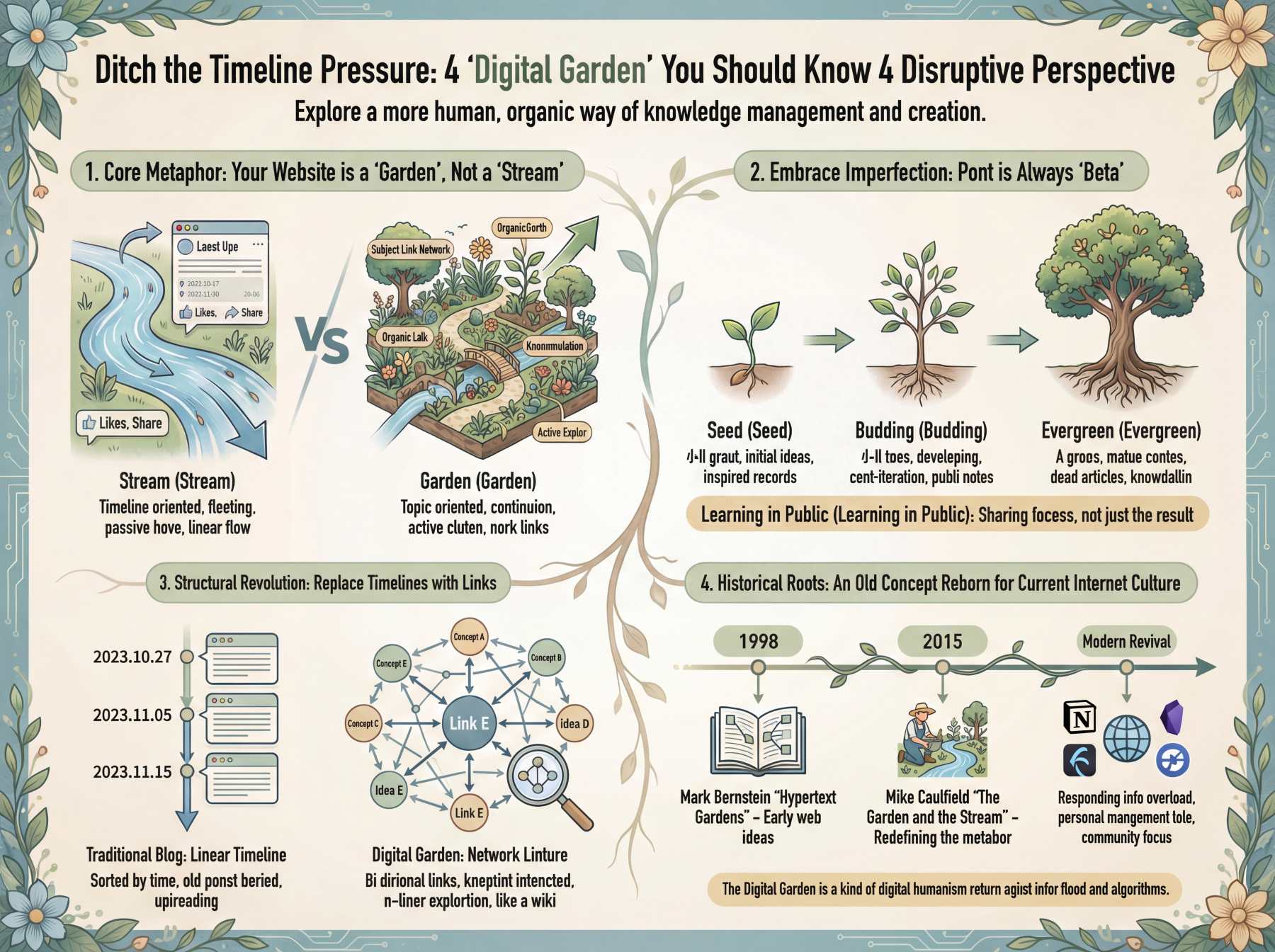
How My Blog Practises the Digital Garden
My blog mainly practises the Digital Garden concept in the following aspects:
Content Grading
I view articles as organic living bodies, not static files.
- Standard Three States
- 🌱 Seedling: Ideas, notes, or brief records that have just sprouted. Telling you: "This is just a note, it might change at any time."
- 🌿 Budding: Articles with a complete structure but still adding details. Telling you: "This is a complete article, but I might continue to update it."
- 🌳 Evergreen: In-depth articles that have stood the test of time and are detailed. (At least for me).
- Special Variants
- 🍎 Fruit: Downloadable resources or tools.
- 🍄 Mushroom: Essays, life insights, or non-technical articles.
- 🌵 Cactus: Articles with strong subjective views or critical nature.
- 🍂 Withered: Outdated technology or projects no longer maintained (e.g., old .NET tutorials).
- 🧱 Trellis: Series guides or index pages.
- Topological Structure: My blog adopts a topological structure rather than a timeline, allowing you to jump freely and explore different themes. You can click on my tags page to see the connections between different themes.
- Bi-directional Linking: My blog uses bi-directional links to connect articles, forming a web-like structure.
Digital Garden Concepts and Figures Summary Table
| Concept or Figure Name | Type | Core Contribution or Definition | Growth Stage or Stage Metaphor | Technical Features or Tools | Historical Status (Inferred) |
|---|---|---|---|---|---|
| Digital Garden | Concept | A non-linear personal knowledge management practice that views the website as an organically growing space, emphasising thought connection and learning in public. | Includes stages such as Seed, Budding/Sapling, Evergreen. | Bi-directional linking, Topological structure, Statiq, Obsidian, Roam Research. | The core framework of contemporary Personal Knowledge Management (PKM) and the "Second Brain" movement, countering the algorithm-driven information stream. |
| Stream | Concept | A way of presenting information in reverse chronological order, emphasising immediacy and fleetingness. | Linear Timeline | Twitter, Facebook, Traditional Blogs. | As the opposite of the Digital Garden, symbolising the information overload and transience caused by modern social media. |
| Topology | Concept | A non-linear organisation method that forms a web-like knowledge map through bi-directional links. | Network (Graph) | Graph Database, Many-to-Many Relationships, Backlinks. | The core feature of the Digital Garden in terms of technology and logical architecture. |
| Mike Caufield | Figure | Published "The Garden and the Stream" in 2015, defining the contrast framework between "Garden" and "Stream". | Garden (Long-term accumulation, Topology) vs. Stream (Short-term, Linear). | ___ | Regarded as the father of the modern Digital Garden, providing the core theoretical and philosophical foundation for the movement. |
| Mark Bernstein | Figure | Published the paper "Hypertext Gardens" in 1998, linking the term "Garden" with hypertext for the first time. | Described the garden as a space between farmland and wilderness, focusing on user exploration experience. | Hypertext | The earliest source of the Digital Garden concept, laying the preliminary idea of hypertext non-linear organisation. |
| Maggie Appleton | Figure | Wrote "A Brief History & Ethos of the Digital Garden", systematically organising the historical context and core values. | ___ | ___ | Important promoter and historian of the Digital Garden, assisting in the revival of the concept between 2018-2020. |
| Joel Hooks | Figure | Proposed the famous statement "My blog is a digital garden, not a blog". | Emphasised the non-linear "sense of unfinishedness". | ___ | Clearly defined the difference between Digital Gardens and traditional blogs, making a significant contribution to community identity. |
| Tom Critchlow | Figure | Wrote several influential articles on building Digital Gardens, providing practical guidance. | ___ | ___ | Key promoter of the Digital Garden at the practical level. |
| Anne-Laure Le Cunff | Figure | Provided building guides through Ness Labs, promoting concept popularisation. | ___ | ___ | Promoting the popularisation of the Digital Garden in the general public and productivity communities. |
- first edition time: 2026-01-25
- last edit time: 2026-01-25