🌿Why Pickleball Is Exploding: Origins, Rules, Skills, and Its Tension with Tennis and Badminton
This article is based on publicly available sources accessible as of May 2026 and is meant to give first-time readers a fast but reliable overview of pickleball.
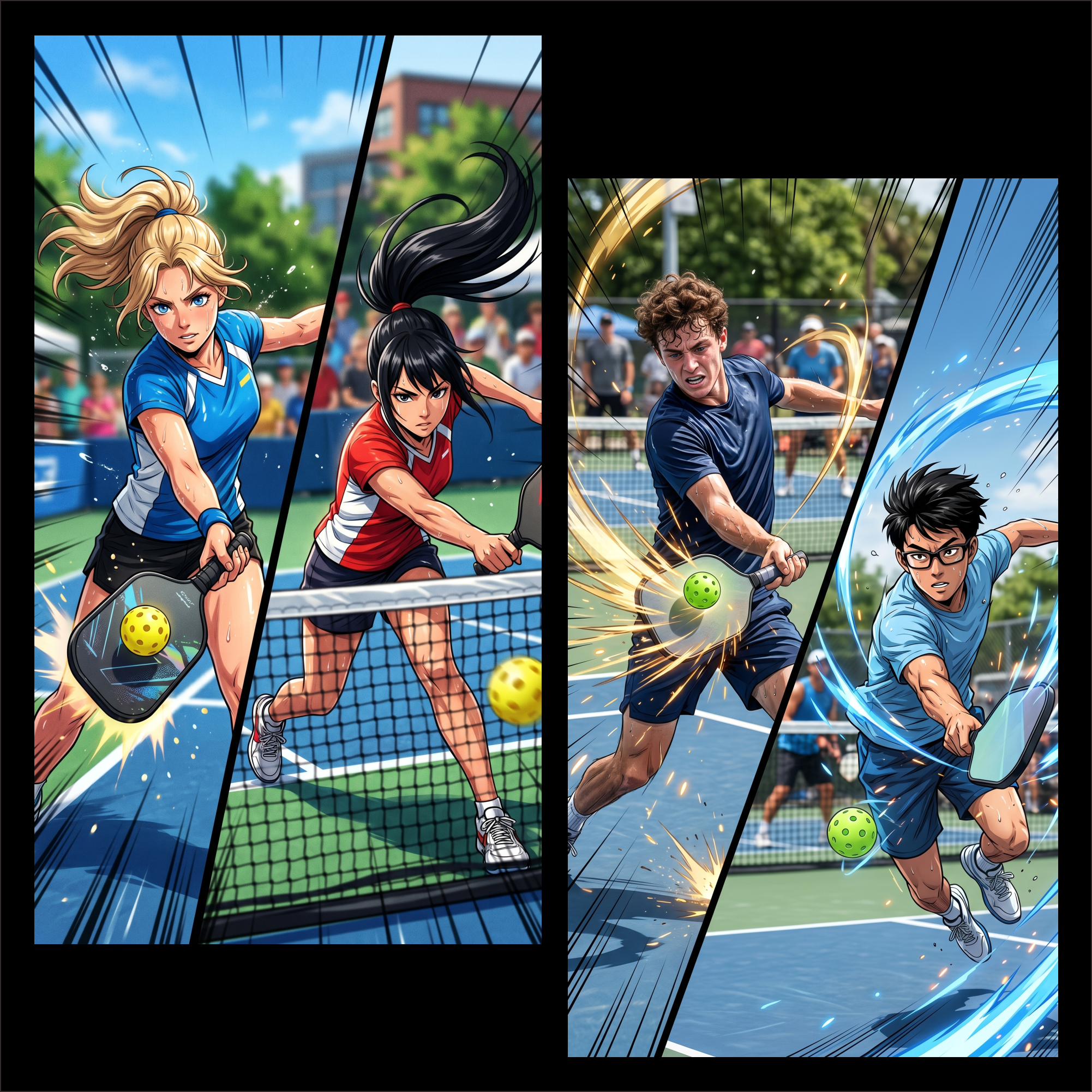
Why Pickleball Is Exploding: Origins, Rules, Skills, and Its Tension with Tennis and Badminton
If you have paid even casual attention to sports media, social feeds, or local courts over the past few years, you've probably heard the word pickleball. Some people describe it as a more accessible cousin of tennis. Others dismiss it as a noisy court-hogging fad. Both reactions miss what is actually happening.
Pickleball has taken off because it sits at the perfect intersection of low entry barrier, strong social appeal, satisfying competition, manageable physical demands, and just enough professional drama to keep the headlines moving. This article is for readers who want the full picture: where the sport came from, how the rules work, what skills matter, how it compares with tennis and badminton, which pro athletes have crossed over, and why the sport keeps stirring debate.
Where Pickleball Came From
Pickleball was invented in 1965 on Bainbridge Island, Washington. Britannica summarizes the origin story clearly: Joel Pritchard, Bill Bell, and Barney McCallum were trying to create a game their families could enjoy together. With incomplete badminton equipment on hand, they improvised using an old badminton court, Ping-Pong paddles, and a perforated plastic ball.
That improvised backyard game slowly became a structured sport. One of the best-known naming stories is that Joan Pritchard thought the mix-and-match nature of the new game resembled a pickle boat in rowing, where athletes from different crews are combined. Another popular myth says the sport was named after the family dog, Pickles, but later accounts from the family pushed back on that version.
The timeline after that moved quickly. The founders established a company in 1972 to advance the sport. The first tournament arrived in 1976. A national governing body and the first official rulebook followed in 1984. What started as a family pastime eventually spread through community centers, retirement communities, schools, clubs, and then into organized competition.
By the 21st century, pickleball was no longer a quirky regional curiosity. Britannica notes that the International Federation of Pickleball was formed in 2010 and that the number of member associations and groups later expanded to more than 60 countries. That matters because it shows pickleball is not just a U.S. trend with good marketing. It is a real sport with institutional growth, international ambition, and staying power.
The Rules in Five Minutes
If you only want the essentials needed to follow a match, start here.
| Core item | Quick explanation |
|---|---|
| Court | 20 x 44 feet for both singles and doubles |
| Serve | Underhand serve or drop serve, hit diagonally into the opposite service box |
| Two-bounce rule | The return of serve must bounce, and the third shot must also bounce |
| Kitchen | A 7-foot non-volley zone on each side of the net where you cannot volley |
| Scoring | Standard games are usually to 11, win by 2; traditional scoring lets only the serving side score |
| Doubles order | In most doubles situations, both players on a team serve before a side-out |
The two defining rules are the two-bounce rule and the kitchen.
The two-bounce rule means the receiving team must let the serve bounce before returning it, and the serving team must let that return bounce before hitting the third shot. After those two bounces, volleys are allowed. This single rule removes the easy advantage of immediately crashing the net after a serve and makes early-rally positioning much more strategic.
Then there is the non-volley zone, universally called the kitchen. You may step into the kitchen to hit a ball that has already bounced, but you may not volley from inside the kitchen or while touching the line. Even more important, if you hit a legal volley outside the kitchen and your momentum carries you into it afterward, it is still a fault. That is why controlled balance near the net matters so much.
Serving also feels very different from tennis. Pickleball serves are underhand, and there is no second serve. One miss and the serving opportunity is gone. That makes consistency more valuable than flair, especially for new players.
The Skills That Matter Most
Pickleball looks simple until you try to win points consistently. Many new players assume the answer is to hit harder. In reality, better pickleball usually comes from better control, better patience, and smarter transitions.
1. Hit deep serves and deep returns
Pickleball.com's technique guides emphasize depth over flash. A short serve gives your opponent an easy path forward. A deep return keeps the serving team back and buys time for the returners to move up. If you are new to the game, a reliable deep serve is more valuable than a spin-heavy serve you cannot repeat.
2. Move to the kitchen line after the return
The return of serve is one of the most important strategic shots in pickleball. A deep return lets the returning team claim the kitchen line while the serving team is still dealing with the third shot from farther back. Good players do not admire their return. They hit it and move.
3. Learn the third shot drop
The third shot drop is often called the most important shot in pickleball for a reason. Its job is not to end the point. Its job is to neutralize the receiving team's advantage at the kitchen line by landing softly in or near the non-volley zone. If the serving team cannot hit a workable third shot drop, it often remains pinned at the baseline.
4. Respect the dink and the reset
The dink is the soft shot exchanged near the kitchen line. The reset is the shot that slows a fast exchange and brings the rally back under control. New players often lose because they try to attack every ball from bad positions. Skilled players know when to absorb pace, soften the ball, and refuse to panic.
5. Attack only when the ball is truly attackable
One of the clearest strategic principles from Pickleball.com's shot-selection guidance is this: balls below net height are usually not for hero shots. They are for resets, drops, or safe neutral balls. Real attack opportunities usually come when the ball sits up above the net or when your opponent's paddle and body position are compromised.
6. Patience wins more points than ego
This may be the hardest lesson for players coming from other racquet sports. A lot of recreational pickleball points are lost, not won. The player who waits for the right ball, maintains a high-percentage pattern, and stays calm during extended dink rallies will often outperform the player trying to force highlights every point.
Pickleball and Tennis: Similarities and Differences
Similarities
- Both are net sports played in singles and doubles on rectangular courts.
- Both reward placement, angles, anticipation, spin, and partner coordination.
- Both revolve around creating better court position before pulling the trigger on attack.
- Both can be played casually or at highly technical competitive levels.
Differences
- The court size is much smaller in pickleball. Tennis uses a 78-foot-long court, with a much greater coverage demand.
- The serve plays a completely different role. In tennis, it is a weapon. In pickleball, it is more of a structured start to the rally.
- The equipment changes the entire feel of the game. Tennis uses strung racquets and felt-covered balls; pickleball uses solid paddles and perforated plastic balls.
- Pickleball has the kitchen and the two-bounce rule, which reshape net play and early-rally tactics.
- Pickleball is generally easier for mixed ages and mixed ability levels to enjoy together, though serious doubles still demands fast hands and sharp reactions.
If tennis is often a large-court blend of endurance, aggression, and space management, pickleball is more often a small-court game of transitions, placement, hand speed, and restraint.
Pickleball and Badminton: Similarities and Differences
Similarities
- A pickleball court has the same footprint as a doubles badminton court: 20 x 44 feet.
- Both sports reward quick hands, front-court reactions, doubles chemistry, and angle creation.
- Both place a premium on moving opponents rather than simply overpowering them.
- Players with badminton backgrounds often feel immediately comfortable with compact exchanges and net instincts.
Differences
- Badminton is fundamentally a volley sport with a shuttlecock; pickleball uses bounce as part of its structure.
- The shuttlecock behaves nothing like a pickleball. Badminton is faster through short exchanges and more sensitive to feather or synthetic flight behavior, while pickleball offers a more predictable bounce-and-control rhythm.
- Badminton's attack patterns are built around overhead pressure, jump smashes, and deep rear-court recovery. Pickleball adds kitchen battles, dinking, resets, and transition-zone management.
- Badminton uses rally scoring to 21, while pickleball still most commonly uses traditional side-out scoring to 11 in standard play.
- Badminton is mostly indoor and protected from wind. Pickleball is often played outdoors, where wind, sun, and surface matter.
If you come from badminton, pickleball may feel spatially familiar but tactically surprising. The quick hands transfer well. The decision-making often does not.
Which Tennis and Badminton Pros Have Crossed Over?
The strongest crossover story is still coming from tennis.
- Andre Agassi: AP reported that Agassi went from being puzzled by the pickleball boom to becoming genuinely hooked on the sport's touch game and kitchen tactics. In 2025 he entered the U.S. Open Pickleball Championships and won his professional debut alongside Anna Leigh Waters.
- Eugenie Bouchard: ESPN reported that Bouchard joined the PPA for the 2024 season while saying she was not fully done with tennis. She openly described the PPA offer as something she could not really refuse.
- Jack Sock, Sam Querrey, and Donald Young: ESPN explicitly cited them as examples of tennis players who had already moved into pickleball competition and helped normalize the crossover.
- James Blake: More visible through high-profile events and exhibitions than a full-time conversion, but still clearly part of the ecosystem around the sport.
If you want a quick feel for how this crossover gets packaged as big-ticket sports entertainment, the Andre Agassi versus Andy Roddick million-dollar pickleball showcase is a good example.
The badminton side is still much thinner in public visibility. There are fewer headline-grabbing, globally recognized badminton-to-pickleball transitions than there are from tennis.
- Wakana Nagahara: JOOLA Japan announced in 2025 that the former Japanese national badminton star, world champion, and former world No. 1 had retired from badminton and begun competing and promoting pickleball. That makes her one of the clearer, verifiable badminton crossover examples currently on record.
That imbalance tells its own story. Tennis crossover is already a mainstream narrative in pickleball. Badminton crossover exists, but it is still earlier, smaller, and less commercially visible.
Gossip, Friction, and Why the Sport Keeps Starting Arguments
1. Tennis is not just mocking pickleball; it is worried about it
During Wimbledon 2024, Novak Djokovic said tennis was in danger at the club level because of the rise of padel in Europe and pickleball in the United States. His point was not simply aesthetic. He argued that clubs would convert tennis space because alternative setups are cheaper and more financially efficient.
That comment landed because it touched the real nerve of the conversation. The tension is not only about sporting prestige. It is about court economics, accessibility, and who gets the space.
2. The funniest version of the debate is that critics still end up playing it
What made the Djokovic discourse even more entertaining is that he later appeared in a pickleball event ahead of the U.S. Open. That created the obvious social-media punchline: first you call it a threat, then you pick up the paddle yourself. From a gossip angle, that is great material. From a broader sports angle, it shows just how impossible the sport has become to ignore.
3. A lot of online chatter broadens this into a "Djokovic family" stance
You will often see online discussions casually attribute anti-pickleball sentiment to the Djokovic family more broadly, including his father. But in this research pass, the most clearly documented and widely quoted mainstream comments were Novak's own statements about tennis, club infrastructure, and accessibility. I did not find equally solid mainstream reporting centered on his father making a definitive pickleball statement, so I would rather be precise than recycle internet noise as fact.
4. The real fight is not which sport is "better"
The loudest arguments can sound like culture war theater: pickleball is for retirees, tennis is elitist, badminton is more athletic, and so on. But underneath the jokes, the real issue is practical. Pickleball is cheaper to set up, easier to fill, easier for beginners to enjoy quickly, and highly effective at turning casual participants into regular social players. That is a powerful combination.
World Trends: Pickleball Is No Longer Just an American Retirement-Community Story
The U.S. numbers are already large enough to force serious attention. SFIA reports that 24.3 million Americans played pickleball in 2025. That represents 479% growth from 2020 to 2025, rising from roughly 4.2 million players to more than 24 million in five years.
The demographic spread matters too. SFIA notes strong participation across multiple age groups, with meaningful engagement among younger adults, adults aged 25 to 44, and players 65 and older. That helps explain why the sport has staying power. It is not being carried by a single generation.
Infrastructure is expanding alongside demand. The summary shown for USA Pickleball's 2025 annual growth report says the Pickleheads database reached 18,258 locations and 82,613 known courts, with 14,155 new courts added in 2024. That is not just enthusiasm. That is build-out.
Internationally, the sport is still at an earlier stage than in the United States, but it is clearly spreading. Britannica points to more than 60 countries tied into the international federation ecosystem. Japan's emerging crossover stories, including Wakana Nagahara, suggest that pickleball is beginning to enter Asian racquet-sport conversations in a more visible way.
That does not mean it will dominate every market equally. In much of Europe, padel has stronger momentum. In Asia, badminton remains deeply rooted. Tennis still owns the most established global professional structure and history. So the realistic conclusion is not that pickleball will replace everything. It is that pickleball has already earned a durable place in the global racquet-sport mix because it offers a rare combination of accessibility and real tactical depth.
Conclusion: Pickleball's Real Superpower Is That It Pulls People Back Onto the Court
Pickleball is not exploding because it is a superior version of tennis or a replacement for badminton. It is exploding because it solves a practical human problem extremely well: it gives a lot of people a fast path into meaningful play.
It is easier to start than tennis, easier to scale in community settings than many traditional court sports, and deep enough to reward obsession once players get hooked. Tennis players discover they need more patience and softer hands than expected. Badminton players discover that their speed helps, but their timing and decision tree must adapt. Complete newcomers discover that a racquet sport does not have to feel impossible on day one.
Whether pickleball eventually becomes an Olympic-level staple or simply settles into a powerful long-term niche, it has already moved far beyond fad status. As of 2026, it is one of the most important new stories in modern racquet sports.